13 10 sub parsers
P4 allows parsers to invoke the services of other parsers, similar to
subroutines. To invoke the services of another parser, the sub-parser
must be first instantiated; the services of an instance are invoked by
calling it using its apply method.
The following example shows a sub-parser invocation:
parser callee(packet_in packet, out IPv4 ipv4) { /* body omitted */ }
parser caller(packet_in packet, out Headers h) {
 callee() subparser;  // instance of callee
 state subroutine {
      subparser.apply(packet, h.ipv4);  // invoke sub-parser
      transition accept;  // accept if sub-parser ends in accept state
 }
}
The semantics of a sub-parser invocation can be described as follows:
- The state invoking the sub-parser is split into two half-states at the parser invocation statement.
- The top half includes a transition to the sub-parser
startstate. - The sub-parser’s
acceptstate is identified with the bottom half of the current state - The sub-parser’s
rejectstate is identified with the reject state of the current parser.
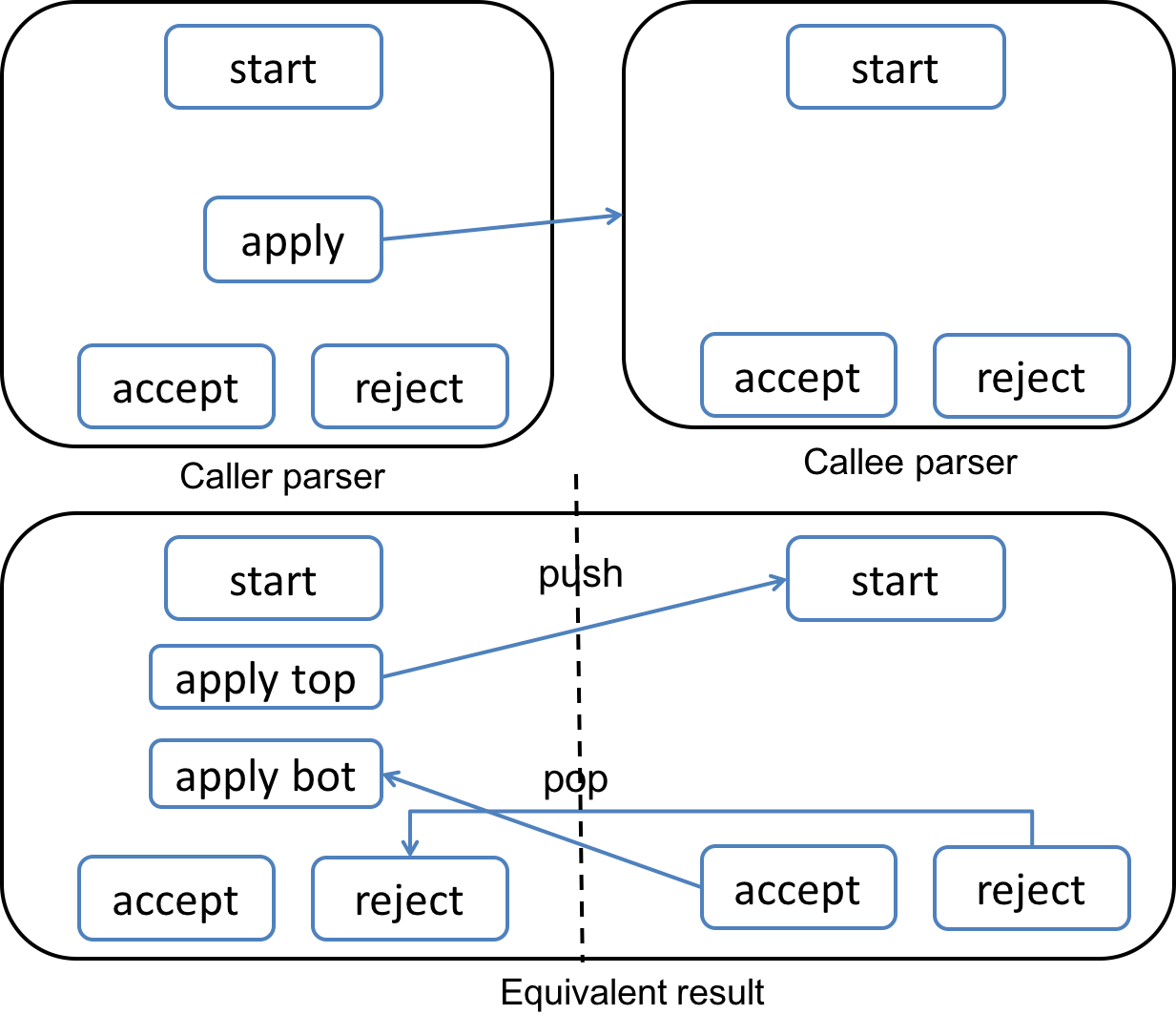
Figure [#fig-subparser] shows a diagram of this process.
Note that since P4 requires definitions to precede uses, it is impossible to create recursive (or mutually recursive) parsers.
When a parser is instantiated, local instantiations of stateful objects are evaluated recursively. That is, each instantiation of a parser has a unique set of local parser value sets, extern objects, inner parser instances, etc. Thus, in general, invoking a parser instance twice is not the same as invoking two copies of the same parser instance. Note however that local variables do not persist across invocations of the parser. This semantics also applies to direct invocation (see Section Direct type invocation).
Architectures may impose (static or dynamic) constraints on the number
of parser states that can be traversed for processing each packet. For
example, a compiler for a specific target may reject parsers containing
loops that cannot be unrolled at compilation time or that may contain
cycles that do not advance the cursor. If a parser aborts execution
dynamically because it exceeded the time budget allocated for parsing,
the parser should transition to reject and set the standard error
error.ParserTimeout.