17 01 example architecture description
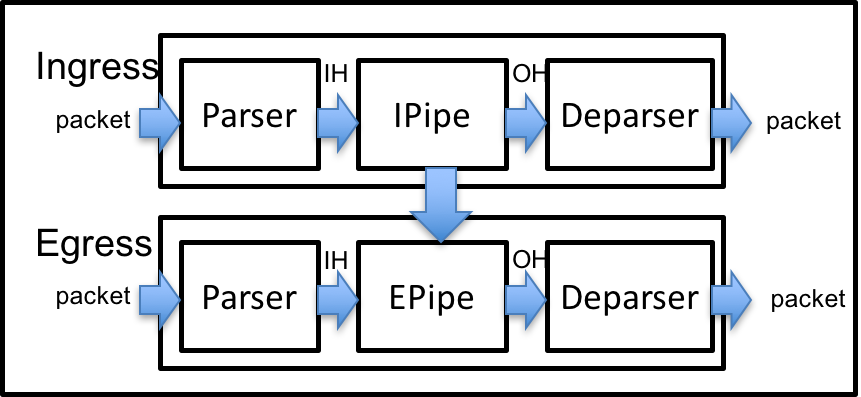
The following example describes a switch by using two packages, each containing a parser, a match-action pipeline, and a deparser:
parser Parser<IH>(packet_in b, out IH parsedHeaders);
// ingress match-action pipeline
control IPipe<T, IH, OH>(in IH inputHeaders,
                         in InControl inCtrl,
                         out OH outputHeaders,
                         out T toEgress,
                         out OutControl outCtrl);
// egress match-action pipeline
control EPipe<T, IH, OH>(in IH inputHeaders,
                         in InControl inCtrl,
                         in T fromIngress,
                         out OH outputHeaders,
                         out OutControl outCtrl);
control Deparser<OH>(in OH outputHeaders, packet_out b);
package Ingress<T, IH, OH>(Parser<IH> p,
                           IPipe<T, IH, OH> map,
                           Deparser<OH> d);
package Egress<T, IH, OH>(Parser<IH> p,
                          EPipe<T, IH, OH> map,
                          Deparser<OH> d);
package Switch<T>(Ingress<T, _, _> ingress, Egress<T, _, _> egress);
Just from these declarations, even without reading a precise description of the target, the programmer can infer some useful information about the architecture of the described switch, as shown in Figure [#fig-switcharch]:
- The switch contains two separate
packagesIngressandEgress. - The
Parser,IPipe, andDeparserin theIngresspackage are chained together in order. In addition, theIngress.IPipeblock has an input of typeIngress.IH, which is an output of theIngress.Parser. - Similarly, the
Parser,EPipe, andDeparserare chained in theEgresspackage. - The
Ingress.IPipeis connected to theEgress.EPipe, because the first outputs a value of typeT, which is an input to the second. Note that the occurrences of the type variableTare instantiated with the same type inSwitch. In contrast, theIngresstypeIHand theEgresstypeIHmay be different. To force them to be the same, we could instead declareIHandOHat the switch level:package Switch<T,IH,OH>(Ingress<T, IH, OH> ingress, Egress<T, IH, OH> egress).
Hence, this architecture models a target switch that contains two separate channels between the ingress and egress pipeline:
- A channel that can pass data directly via its argument of type
T. On a software target with shared memory between ingress and egress this could be implemented by passing directly a pointer; on an architecture without shared memory presumably the compiler will need to automatically synthesize serialization code. - A channel that can pass data indirectly using a parser and deparser that serializes data into a packet and back.