18 03 control plane names
Every controllable entity exposed in a P4 program must be assigned a unique, fully-qualified name, which the control plane may use to interact with that entity. The following entities are controllable.
- value sets
- tables
- keys
- actions
- extern instances
A fully qualified name consists of the local name of a controllable entity prepended with the fully qualified name of its enclosing namespace. Hence, the following program constructs, which enclose controllable entities, must themselves have unique, fully-qualified names.
- control instances
- parser instances
Evaluation may create multiple instances from one type, each of which must have a unique, fully-qualified name.
Computing control-plane names
The fully-qualified name of a construct is derived by concatenating the fully-qualified name of its enclosing construct with its local name. Constructs with no enclosing namespace, i.e. those defined at the global scope, have the same local and fully-qualified names. The local names of controllable entities and enclosing constructs are derived from the syntax of a P4 program as follows.
Value sets
For each value_set construct, its syntactic name becomes the local
name of the value set. For example:
struct vsk_t {
    @match(ternary)
    bit<16> port;
}
value_set<vsk_t>(4) pvs;
This value_set’s local name is pvs.
Tables
For each table construct, its syntactic name becomes the local name of
the table. For example:
control c(/* parameters omitted */)() {
    table t { /* body omitted */ }
}
This table’s local name is t.
Keys
Syntactically, table keys are expressions. For simple expressions, the local key name can be generated from the expression itself; the algorithm by which a compiler derives control-plane names for complex key expressions is target-dependent.
The spec suggests, but does not mandate, the following algorithm for generating names for some kinds of key expressions:
| Kind | Example | Name |
|---|---|---|
The isValid() method. |
h.isValid() |
"h.isValid()" |
| Array accesses. | header_stack[1] |
"header_stack[1]" |
| Constants. | 1 |
"1" |
| Field projections. | data.f1 |
"data.f1" |
| Slices. | f1[3:0] |
"f1[3:0]" |
| Masks. | h.src & 0xFFFF |
"h.src & 0xFFFF" |
In the following example, the previous algorithm would derive for table
t two keys with names data.f1 and hdrs[3].f2.
table t {
    keys = {
        data.f1 : exact;
        hdrs[3].f2 : exact;
    }
    actions = { /* body omitted */ }
}
If a compiler cannot generate a name for a key it requires the key
expression to be annotated with a @name annotation (Section
Control-plane API annotations), as in the following example:
table t {
    keys = {
        data.f1 + 1 : exact @name("f1_mask");
    }
    actions = { /* body omitted */ }
}
Here, the @name("f1_mask") annotation assigns the local name
"f1_mask" to this key.
Actions
For each action construct, its syntactic name is the local name of the
action. For example:
control c(/* parameters omitted */)() {
    action a(...) { /* body omitted */ }
}
This action’s local name is a.
Instances
The local names of extern, parser, and control instances are
derived based on how the instance is used. If the instance is bound to a
name, that name becomes its local control plane name. For example, if
control C is declared as,
control C(/* parameters omitted */)() { /* body omitted */ }
and instantiated as,
C(E()) c_inst;
then the local name of the instance is c_inst.
Alternatively, if the instance is created as an actual argument, then
its local name is the name of the formal parameter to which it will be
bound. For example, if extern E and control C are declared as,
extern E { /* body omitted */ }
control C( /* parameters omitted */ )(E e_in) { /* body omitted */ }
and instantiated as,
C() c_inst;
then the local name of the extern instance is e_in.
If the construct being instantiated is passed as an argument to a
package, the instance name is derived from the user-supplied type
definition when possible. In the following example, the local name of
the instance of MyC is c, and the local name of the extern is
e2, not e1.
extern E { /* body omitted */ }
control ArchC(E e1);
package Arch(ArchC c);

control MyC(E e2)() { /* body omitted */ }
Arch(MyC()) main;
Note that in this example, the architecture will supply an instance of
the extern when it applies the instance of MyC passed to the Arch
package. The fully-qualified name of that instance is main.c.e2.
Next, consider a larger example that demonstrates name generation when there are multiple instances.
control Callee() {
    table t { /* body omitted */ }
    apply { t.apply(); }
}
control Caller() {
    Callee() c1;
    Callee() c2;
    apply {
       c1.apply();
       c2.apply();
    }
}
control Simple();
package Top(Simple s);
Top(Caller()) main;
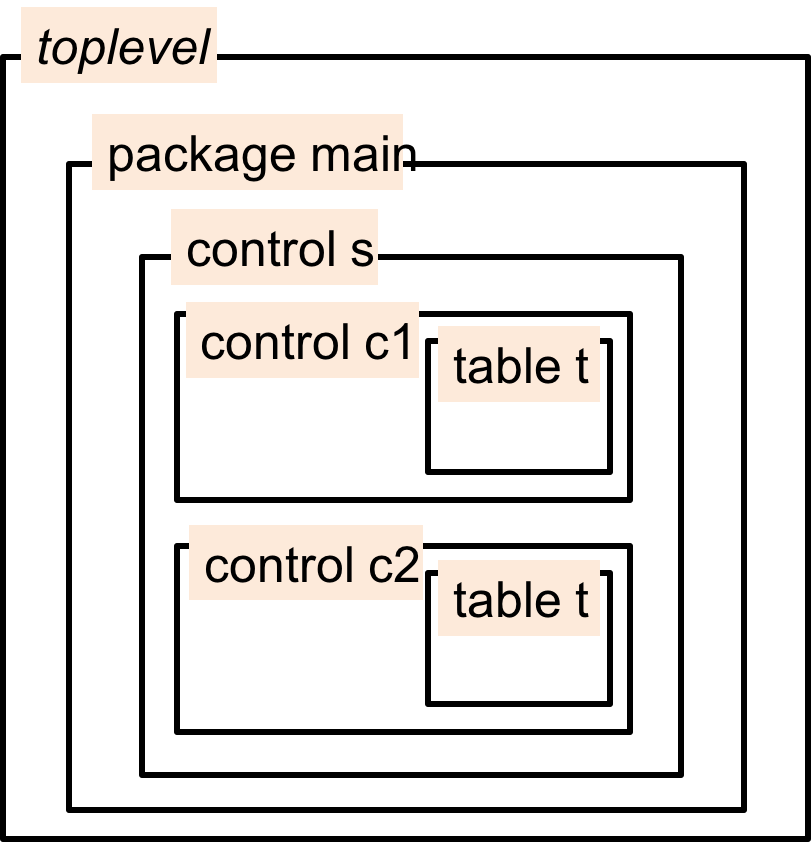
The compile-time evaluation of this program produces the structure in
Figure [#fig-evalmultiple]. Notice that there are two instances of
the table t. These instances must both be exposed to the control
plane. To name an object in this hierarchy, one uses a path composed of
the names of containing instances. In this case, the two tables have
names s.c1.t and s.c2.t, where s is the name of the argument to
the package instantiation, which is derived from the name of its
corresponding formal parameter.
Annotations controlling naming
Control plane-related annotations (Section Control-plane API annotations) can alter the names exposed to the control plane in the following ways.
-
The
@hiddenannotation hides a controllable entity from the control plane. This is the only case in which a controllable entity is not required to have a unique, fully-qualified name. -
The
@nameannotation may be used to change the local name of a controllable entity.
Programs that yield the same fully-qualified name for two different controllable entities are invalid.
Recommendations
The control plane may refer to a controllable entity by a postfix of its fully qualified name when it is unambiguous in the context in which it is used. Consider the following example.
control c( /* parameters omitted */ )() {
    action a ( /* parameters omitted */ ) { /* body omitted */ }
    table t {
        keys = { /* body omitted */ }
        actions = { a; } }
}
c() c_inst;
Control plane software may refer to action c_inst.a as a when
inserting rules into table c_inst.t, because it is clear from the
definition of the table which action a refers to.
Not all unambiguous postfix shortcuts are recommended. For instance,
consider the first example in Section Control plane names. One might be
tempted to refer to s.c1 simply as c1, as no other instance named
c1 appears in the program. However, this leads to a brittle program
since future modifications can never introduce an instance named c1,
or include libraries of P4 code that contain instances with that name.